ACV Buyer's Guide

May 1, 2026
Support Center

/

ACV Buyer's Guide

ACV Buyers Guide

Lights, Disclosures, Limitations & Red Light Arbitrations

What This Is: A clear, concise guide to help buyers understand arbitration eligibility and disclosure standards on ACV Auctions.

What This Isn’t: A replacement for ACV’s posted legal Arbitration terms. Want to dive into the legalese? Click here.

Auction Lighting System Explained

Each vehicle on ACV is assigned a light color that determines the level of arbitration protection and disclosure expectations:

🟢 Green Light

When you see a Green Light, you’re backed by ACV’s industry-leading protection. If you discover a major mechanical, structural, or undisclosed wear-and-tear issue that costs over $800 to fix, we’ve got your back through our arbitration process.

💡 Pro-Tip: While the Green Light offers great peace of mind, remember these are wholesale units! We recommend budgeting for reconditioning to get them front-line-ready.

🟡 Yellow Light

Unlike other auctions that might 'Yellow Light' an entire vehicle for one issue, ACV uses Component-Level Lighting. We only exclude the specific part disclosed, so you keep your arbitration rights on the rest of the unit. It’s our way of giving you the most protection possible while staying 100% transparent.

💬 Keep in Mind: When a component is yellow-lit, the seller has flagged specific issues with that component on the vehicle. Because these conditions are already disclosed, the entire component is sold "as-is" and is not eligible for arbitration. We want you to bid with total confidence, so please budget for the possibility of anything from a minor repair to a full replacement of that part.

🔴 Red Light

A vehicle sold "as-is" and ineligible for arbitration with very limited exceptions. See "Can I Arbitrate a Red-Light Vehicle?" section below.

🔵 Blue Light

We believe in no surprises when it comes to your paperwork. A Blue Light simply means the seller is currently processing the title.

  • Blue Light Active: The seller has up to 30 days to deliver the title (45 days in California).
  • No Blue Light? Even better! You can expect the title to be delivered to ACV within 7 calendar days of sale.

What Counts as a Disclosed Condition?

Conditions visible or documented in the listing at the time of sale are considered disclosed and are not eligible for arbitration. This includes:
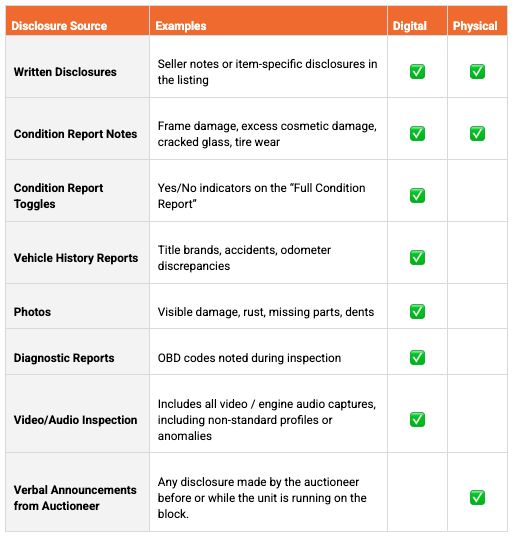
Please Note: Certain vehicle defects may appear in multiple disclosure methods listed above. For arbitration, any of these methods constitutes valid disclosure, and no single method overrides another.

Why Excess Wear and Tear Must Be Disclosed

We know you know cars—nobody expects an older, high-mileage, wholesale unit to look front-line-ready, and standard wear is expected. That’s why our policy focuses strictly on the unexpected.

We require sellers to clearly disclose major flaws that go beyond normal industry expectations. This keeps the playing field level and ensures that if any major, undisclosed excess wear slips through the cracks, it remains fully eligible for arbitration. You can spot the real opportunities and bid with total confidence.

Examples of Normal v. Excess Wear and Tear

Remember: requirements can vary depending on a vehicle's age & mileage!

What Is Not Eligible for Arbitration Per NAAA Guidelines

We align with National Auto Auction Association (NAAA) guidelines to keep wholesale bidding consistent, fair, and predictable for everyone. To protect your margins and save you time, these standard industry parameters clarify what falls under normal wholesale expectations versus what qualifies for arbitration:

  • Timelines: To keep the marketplace moving, ensure any necessary claims are submitted within your designated arbitration window (including any extensions via ACV Transportation or Buyer Assurance). Without any add-ons, remember that the standard arb window on ACV is 10 calendar days.
  • The $800 Recon Threshold: To keep focus on the major issues, individual mechanical or structural defects under $800 are considered standard wholesale reconditioning costs rather than auction defects.
    • Units >$50k: Remember that this threshold for units sold over $50,000 is 2% of the purchase price for individual defects!
  • Everyday Cosmetic Wear: Standard dings, minor scratches, and typical interior wear are expected depending on the vehicle's age and mileage.
  • Wearable Components: Items naturally designed to wear out over time—like brakes, clutches, belts, hoses, wipers, and tires—are part of standard inventory prep.
  • Normal Noise & Vibrations: Minor road noise and typical vibrations are considered standard unless they are tied to a misrepresented structural defect or drivability claim.
  • Minor Fluid Leaks: Small, routine seeps or leaks are common on wholesale units and aren't subject to claims unless they are severe and completely undisclosed.
  • Cabin Conveniences: Non-safety accessory issues—such as a finicky radio, window switch, sunroof, or air conditioning—fall under normal reconditioning.
  • Aftermarket Modifications: Custom alterations or aftermarket parts are considered part of the vehicle's unique history unless they were misrepresented in the listing.
  • Warranty-Eligible Repairs: Any issue fully covered by an active OEM factory warranty, or recognized as an inherent manufacturer defect, is not eligible for auction arbitration.

Can I Arbitrate a Red Light Vehicle?

Yes, but only for specific high-risk issues that were not disclosed prior to the sale. For example: 

  • Undisclosed Structural Damage: Meets NAAA definition and was not listed
  • Title or Vehicle History Issues: Missing, branded, or non-transferable titles
  • Odometer Tampering: Mismatch between title and vehicle or rollback
  • Incorrect Representation: Wrong trim, year, engine, or VIN mismatch
  • Vehicle Not Drivable: If described as drivable but is unsafe or inoperable
  • Catalytic Converter Missing: If removed and not disclosed
  • Severe Biohazard or Odor: If not reasonably discoverable in photos or CR

What Cannot Be Arbitrated on Red Light Vehicles

These issues are generally considered part of an as-is sale and are not valid grounds for arbitration:

  • Mechanical Problems: Transmission slip, A/C not functioning
  • Cosmetic Wear (Normal Wear & Tear): Scratches, dings, faded paint
  • Minor Interior Wear: Stains, worn seats or panels
  • Noise or Vibration: Unless tied to safety/drivability and misrepresented
  • Battery or Tire Condition: Unless unsafe or completely absent and undisclosed

What to Do If a Vehicle Is Inoperable Upon Pickup

We work hard to ensure smooth handoffs, but if you arrive to pick up a vehicle and find it is inoperable—despite being listed as drivable—please follow these steps to protect your purchase and ensure a quick resolution:

  1. Verify the CR: Quickly double-check the Condition Report to confirm the vehicle wasn’t originally represented as an inoperable or unsafe unit.
  2. Document the Issue: Take clear photos or a quick video of the condition (e.g., flat tires, dead battery, or an engine that won’t start).
  3. Leave It Parked: Avoid attempting to drive or move the vehicle, as this could worsen the damage or create safety risks.
  4. File a Claim Immediately: Log into MyACV and submit an arbitration claim right away so our team can review it within the required timeframe.
  5. Keep Your Records: Retain all transport invoices and pickup documentation to help us fast-track your claim.

ACV Purchase Protection

Purchase Protection is a subscription offering available for eligible buyers at the most advantageous rate

Buyers participating in the Purchase Protection subscription program at the time of purchase will have a limited right to cancel the vehicle sale if their transaction meets certain conditions. To be eligible for cancellation, the vehicle transaction must meet the following criteria:

  1. The vehicle does not fall within any of the following categories:
    • Red-light vehicles
    • Vehicle sale price of $75,000 or more
    • Vehicles with mileage of 175,000 miles or more at the time of sale
    • Exotic vehicles as determined by ACV (which includes, but is not limited to Bentley, Bugatti, McLaren, Lamborghini, Ferrari, and similar vehicles)
    • Powersports, heavy equipment, electric vehicles, and Class 4 or higher vehicles
  1. The defect or condition for which arbitration is sought is valid and has an ACV estimated repair cost above the minimum arbitration threshold.
  1. The vehicle sale amount does not exceed 110% of the estimated vehicle amount determined by ACV in its sole discretion.
  1. The vehicle is otherwise eligible for arbitration based on the conditions set forth in ACV’s Arbitration Policy.

If ACV determines that the transaction qualifies for cancellation, Buyer will receive a refund equal to the buy fee paid by Buyer as well as the purchase price of the vehicle. Please note that the offering and associated subscription rate may change based on utilization (cancelation & valid arb rates) over time.

Full details of the policy can be found here: https://www.acvauctions.com/legal/purchase-protection-terms

Related articles